When you shop for a water purification system for your home or business, you’ll quickly discover that there are many types of filters. This doesn’t even take into consideration the many brands and specifications within those brands.
Why should you choose one type of system over another? Do certain purification systems filter better? Are there specific use cases or reasons to buy one water purification system over another? This article will review the common water purification systems and help you understand and decide which system will be the best for you.Reverse Osmosis Systems
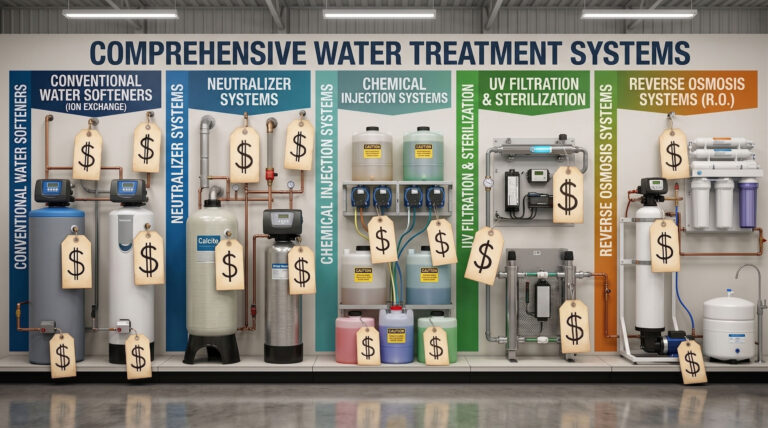
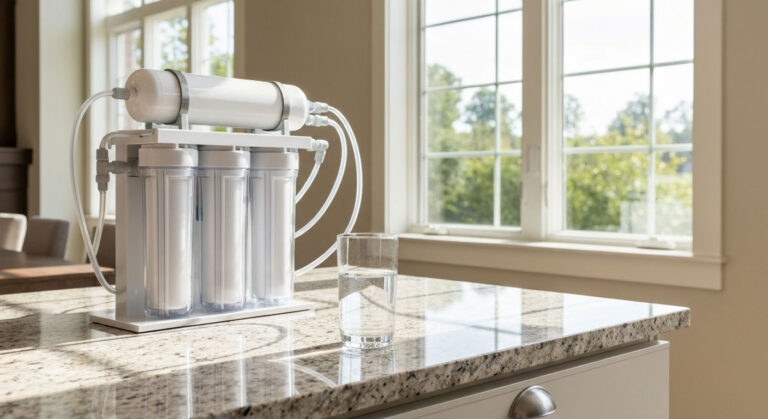
A reverse osmosis water filtration system works by forcing the water through semi-permeable membranes. This membrane allows the water to flow through the membrane but does not allow any contamination or minerals to pass through. Due to the cost of a whole-home system, typically reverse osmosis systems are of the point-of-use variety which allows them to operate at the source of drinking water.
- Extremely effective at removing chemicals and contaminants due to multiple filters.
- Simple maintenance (but filters do need to be monitored!).
[/fusion_content_box]
- Unnecessary on a whole-house level.
- Can remove desirable minerals so these must be added back in if desired.
- Requires good water pressure to force the water through the filters.
- Higher water use to wash away impurities.
[/fusion_content_box][/fusion_content_boxes]Ultra-Violet Filters
Ultra-violet filters expose water to ultra-violet light through a UV chamber which destroys 99.99% of bacteria, viruses, and other microbes that can cause illness and sickness. An important point about UV filters is that, by themselves, they will not fully purify your water. UV filters do nothing to rid the water of sediment or other contaminants like heavy metals.
- A cost-effective solution for killing harmful microbes.
- Does not introduce anything new into the water.
- Simple maintenance.
[/fusion_content_box]
- UV filters do not fully purify the water but, instead, work in conjunction with another system.
- Cannot do its job if water is particularly dirty (e.g. full of sediment).
[/fusion_content_box][/fusion_content_boxes]Activated Carbon Filters
Activated carbon filters works when water flows through granular or powdered carbon that has been treated to be porous. When water flows through, the contaminants in the water react with the carbon and it causes them to stick to the filter. AC filters are often serve as a pre or post filter in a whole-home system or as a filter at a point of consumption such as a pitcher filter, under-sink filter, or a refrigerator filter.
- Removes chlorine, sediment, and other organic compounds
- Does an excellent job of improving the taste and smell of water.
- Inexpensive
- Versatile and commonly used at varying stages of water treatment systems
[/fusion_content_box]
- Will not remove all types of contaminants
- Filters need to be replaced based on the usage of the water that is passing through them
- May not be effective in certain scenarios or with certain filter media
[/fusion_content_box][/fusion_content_boxes]Distillation Systems
Water distillation systems work by boiling water. Once the water has turned to steam, it is then cooled down. As it cools, the water is gathered into a clean container. This process does a remarkable job of removing impurities, but because of the time it takes, it is recommended using this type of system for drinking water for families with countertop distillers.
- Removes most contaminants
- Improves the smell and taste of water
[/fusion_content_box]
- Slow to produce clean water making it impractical for certain uses
- High maintenance unless water is softened prior to distilling. Calcium and magnesium in water quickly clogs a distiller.
[/fusion_content_box][/fusion_content_boxes]Ion Exchange Systems
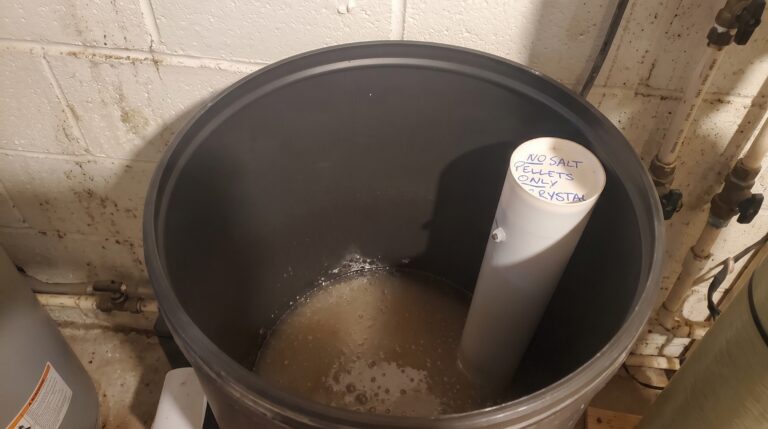
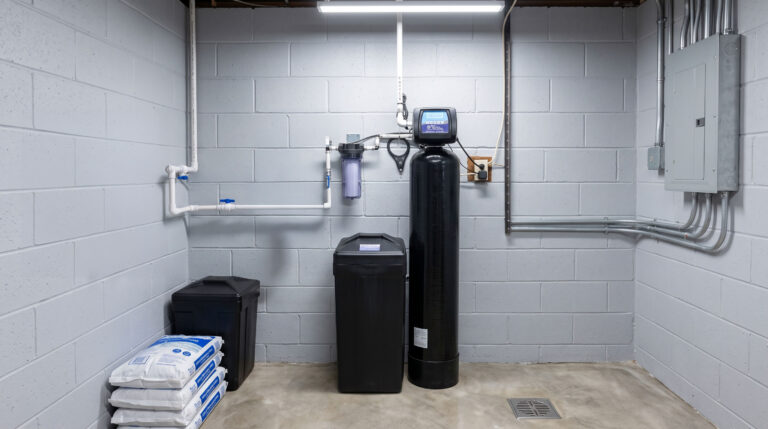
Ion exchange is a fancy name for what most people know as water softeners. This system is not a filter, per se, but water softeners do a lot of work to ensure that common problems from hard water do not cause issues in your home. An ion exchange system is a key component in treating your water. In southeastern PA, in particular, hard water is a considerable problem so a water softener should be seriously considered.
- Removes calcium and magnesium from your water ensuring that hard water does not damage your home.
- Keep hair and skin soft; soap will lather better.
- Protect appliances and other machines in your home that use water.
[/fusion_content_box]
- Does not filter water or disinfect the water.
- Need to regularly maintain sodium or potassium. This will cost around $10 a bag for sodium and 3x as much for potassium.
- Introduces sodium into the water which may not be good for individuals on a no sodium diet.
[/fusion_content_box][/fusion_content_boxes]Summary
When choosing water purification systems for your home or business, there are many different options depending on your water usage patterns, the current quality of your water, and your desired level of water purification. Many times, multiple systems working together provide the best purification, but at a higher cost. Weigh the pros and cons and contact us at Dierolf Plumbing and Water Treatment to get information specifically for your needs.