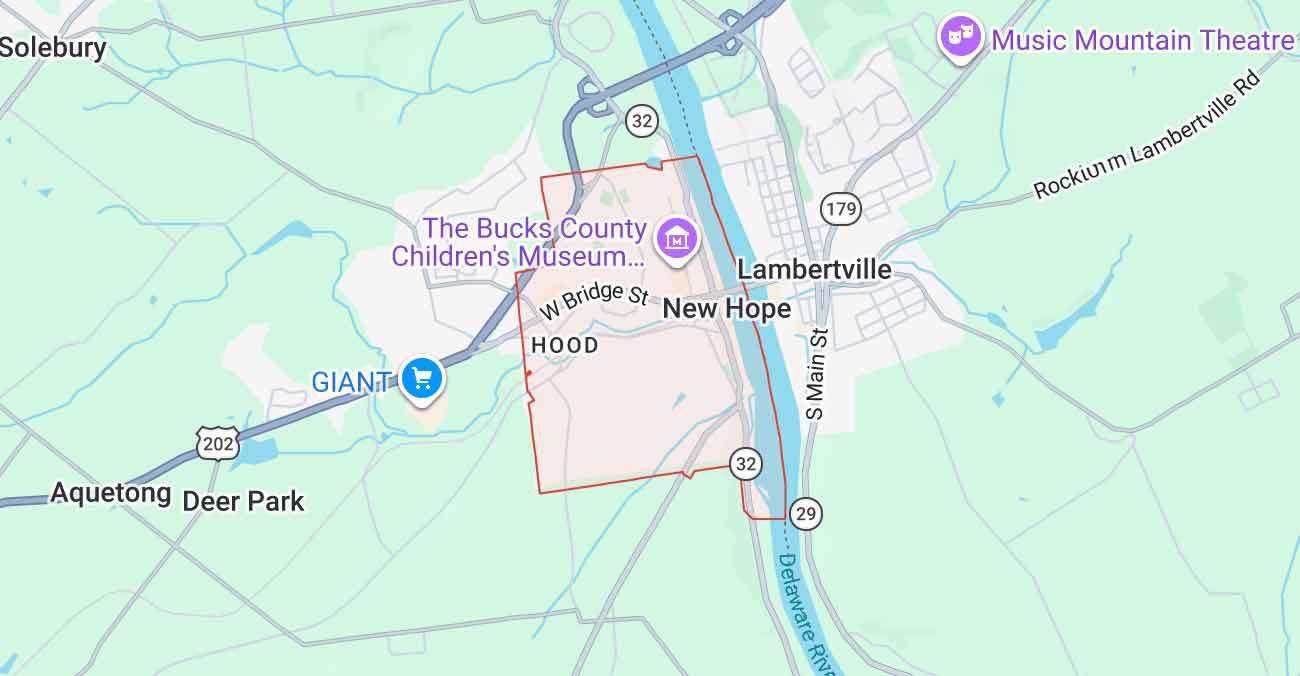
New Hope Borough‘s drinking water is supplied by New Hope Borough Water Department and sourced primarily from the Delaware River watershed, a surface water system influenced by upstream activity across Pennsylvania and New Jersey. Treatment includes filtration and disinfection, typically with chlorine, which can lead to disinfection byproducts such as HAA5.
While the water meets federal and state standards enforced by the U.S. Environmental Protection Agency, local data and regional patterns show recurring concerns around disinfection byproducts, hardness, and trace PFAS compounds linked to broader Delaware River basin activity.
Homes with older plumbing may also see metals like lead or copper from internal pipes, not the municipal supply. Private well users in surrounding Solebury Township face entirely different risks, including bacteria and nitrates.
Testing becomes important when water taste changes, after moving into a home, or when using a private well. Treatment depends on the specific issue, not assumptions.
Understanding New Hope’s Water System
New Hope sits along one of the most historically and environmentally significant water sources in the region: the Delaware River. Unlike groundwater-fed systems common in rural Bucks County, this is a surface water supply, which behaves very differently throughout the year.
Surface water sources like the Delaware River are more vulnerable to:
- Upstream industrial discharge
- Stormwater runoff
- Agricultural nutrient loading
- Seasonal organic material fluctuations
Because of this, treatment is more complex. The borough relies on a multi-step process that typically includes:
- Coagulation and filtration to remove sediment and particulates
- Disinfection using chlorine to eliminate pathogens
- Ongoing monitoring for regulated contaminants
You can review detailed annual findings in the borough’s water quality report here.
A broader watershed overview is available through the Delaware River Basin Commission.
One important local characteristic is seasonal variability. During warmer months, higher organic content in river water can increase the formation of disinfection byproducts when chlorine is added. That is where compounds like HAA5 enter the conversation.
What New Hope Homeowners Are Actually Asking
Is New Hope’s tap water safe to drink?
Yes, the water meets federal safety standards set by the U.S. Environmental Protection Agency. However, “safe” under regulatory definitions does not mean free from all contaminants. Many substances, including disinfection byproducts and PFAS, are allowed at low levels based on long-term exposure thresholds rather than zero presence.
Why does my water sometimes taste or smell like chlorine?
Chlorine is added during treatment to kill bacteria and viruses. In a surface water system like New Hope’s, maintaining disinfectant levels throughout the distribution system is critical. Warmer weather and longer water residence times can make chlorine taste and odor more noticeable.
Learn more about chlorine in drinking water from the U.S. Environmental Protection Agency.
What are disinfection byproducts like HAA5 and should I be concerned?
HAA5, or haloacetic acids, form when chlorine reacts with natural organic matter in water. These compounds are common in surface water systems. Long-term exposure above regulatory limits has been associated with health risks, which is why they are monitored closely.
Is PFAS a concern in New Hope?
PFAS compounds have been detected at low levels across much of southeastern Pennsylvania due to historical industrial activity. While New Hope’s system complies with current standards, the Delaware River watershed has been part of broader PFAS monitoring efforts.
The Pennsylvania Department of Environmental Protection provides updates here.
Why do I get white buildup on fixtures and glassware?
That is hardness, caused by calcium and magnesium. While New Hope’s surface water is not as hard as many well systems in Bucks County, hardness is still present and can fluctuate depending on treatment conditions and blending.
Hard water does not pose a health risk, but it affects:
- Soap performance
- Appliance lifespan
- Scale buildup in water heaters
Could my home’s plumbing be affecting my water quality?
Yes. In many cases, issues like metallic taste, discoloration, or elevated lead come from inside the home. Older homes in New Hope may still have legacy plumbing materials that contribute to water quality changes at the tap.
The U.S. Environmental Protection Agency explains this clearly.
Do I need to test my water if I’m on public supply?
Testing is recommended when:
- Moving into a new home
- Experiencing taste, odor, or staining issues
- Having young children or health concerns
- Wanting to evaluate PFAS or disinfection byproducts more closely
Municipal testing reflects system-wide averages, not individual homes. If you want a clearer picture of what’s coming out of your tap, schedule a free water test with our local team.
What about homes on wells near New Hope?
Private wells are common just outside the borough in areas like Solebury Township. These are not regulated by the EPA. Common issues include:
- Coliform bacteria
- Nitrates from runoff
- Iron and manganese
- Low pH
Penn State Extension provides helpful well water guidance.
Why does my water sometimes look cloudy?
Cloudiness is often caused by air bubbles, especially when water pressure changes. If it clears from bottom to top in a glass, it is typically harmless. Persistent cloudiness may indicate sediment or filtration issues.
Is bottled water safer than tap water here?
Not necessarily. Bottled water is regulated differently and is often just treated municipal water. In most cases, targeted treatment at home provides better control and transparency than relying on bottled sources.
Local Environmental Context That Matters
New Hope’s location along the Delaware River places it downstream of decades of industrial, agricultural, and urban activity. While regulations have significantly improved water quality over time, legacy contaminants remain part of the broader watershed conversation.
Regional monitoring by the Delaware River Basin Commission continues to evaluate:
- PFAS distribution across the basin
- Nutrient loading from upstream agriculture
- Industrial discharge impacts
- Sediment and organic material trends
Unlike groundwater systems, surface water reflects what is happening upstream. That does not make it unsafe, but it does make it dynamic.
For homeowners, the key distinction is this:
- Public water is regulated, treated, and monitored
- Private wells are unregulated and entirely the homeowner’s responsibility
That difference alone changes how water should be approached.
What New Hope Homeowners Should Do
If You Are on Public Water
Start with awareness, not assumptions.
- Review your local water report annually
- Pay attention to changes in taste, smell, or appearance
- Consider targeted testing if you want clarity beyond system averages
If concerns are identified, solutions are specific:
- Carbon filtration for chlorine and disinfection byproducts
- Reverse osmosis for PFAS and dissolved contaminants
- Water softening for hardness
The goal is not to over-treat, but to match the solution to the actual condition. Not sure where to start? Get a free water test and we’ll help you figure it out.
If You Are on a Private Well
Testing is essential, not optional.
At a minimum:
- Annual bacteria testing
- Periodic nitrate testing
- Full panel every few years or when issues arise
Treatment systems vary widely depending on results, which is why testing comes first.
A Local Perspective on Getting It Right
Water quality in New Hope is not a problem to panic about, but it is not something to ignore either. Between a surface water source, regional environmental history, and aging infrastructure in some homes, there are enough variables that a one-size-fits-all answer does not work.
That is where local expertise matters.
At Dierolf Plumbing and Water Treatment, we have spent decades working with homeowners across Bucks and Montgomery County, helping them understand exactly what is in their water and what, if anything, should be done about it.
If you want clarity, the right first step is simple. Test the water. From there, decisions become straightforward.
Next steps:
- Review your New Hope Borough annual water quality report to understand what’s been detected in your system
- Consider a free in-home water test for a clearer picture of what’s actually coming out of your tap — especially if you have concerns about PFAS, disinfection byproducts, or hardness
- If you’re on a private well in Solebury Township or surrounding areas, schedule testing for bacteria and nitrates at minimum
👇 Ready to find out what’s in your water? Please fill out the form below to get started.