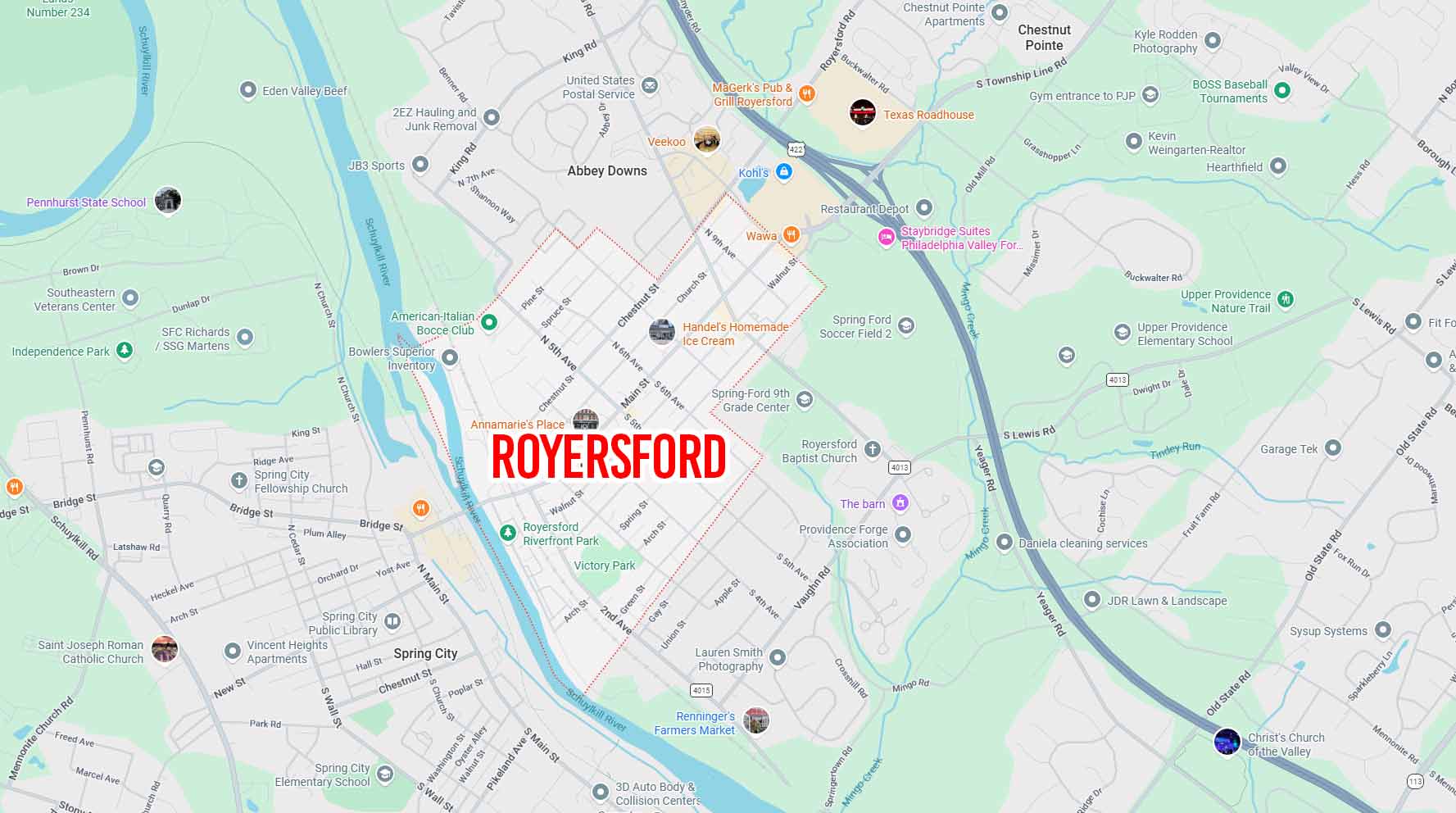
Royersford’s public water comes from a blended supply operated by Pennsylvania American Water. The system relies primarily on the Schuylkill River, with additional groundwater from wells in East Vincent Township and Upper Providence Township, plus a small interconnection with the Norristown system. The 2024 Royersford Consumer Confidence Report says the water met state and federal drinking water requirements, but it also showed measurable levels of PFAS, arsenic, total trihalomethanes, haloacetic acids, nitrates, and hardness. For many Royersford homeowners, the biggest practical concerns are not whether the water is “legal,” but whether they want to reduce long-term exposure to PFAS and disinfection byproducts, improve taste and odor, or soften hard water. Homes on private wells in the wider Royersford area face a different set of issues because well owners, not the utility, are responsible for testing and treatment.
How Royersford’s Water System Actually Works
Royersford is served by Pennsylvania American Water’s Royersford/Home Water System. The utility’s 2024 report says the raw supply is a combination of surface water and groundwater. The surface water comes from the Schuylkill River, and the report notes that roughly 1,100 square miles in 11 counties drain upstream of the intake. Groundwater for the system comes from three wells, including two in Upper Providence Township in Montgomery County and one in East Vincent Township in Chester County. A small portion of supply also comes through an interconnection with the Norristown system, which also uses Schuylkill River water.
That sourcing matters because surface water systems behave differently from deep isolated groundwater systems. River water changes with weather, runoff, upstream activity, and seasonal organic loading. The Royersford report says the source water assessment ranked the system as highly susceptible to contamination from stormwater runoff because the supplies are above ground and exposed to land-use activity in the watershed. That does not mean unsafe drinking water is being delivered, but it does explain why source protection, treatment performance, and ongoing monitoring matter so much in a community like Royersford.
The utility disinfects the supply with chlorine. In the Royersford report, distribution system chlorine residual averaged 1.56 ppm, and the utility also reported disinfection byproducts that form when disinfectants react with naturally occurring material in source water. The highest locational running annual average for total trihalomethanes was 56.7 ppb, and haloacetic acids reached 48.8 ppb. Both were within current federal limits, but they are still important data points for homeowners who are trying to understand taste, odor, and long-term exposure tradeoffs that are common in surface-water-fed systems.
Royersford’s 2024 report also shows total hardness around 150 ppm, or about 8.76 grains per gallon, which is enough for many families to notice spotting, soap inefficiency, scale buildup, and that unwanted “hard water” feel. Depending on where you are in the service area and how much blended groundwater is entering the system, some homes may notice these symptoms more than others.
The Questions Royersford Homeowners Are Really Asking
Is Royersford’s tap water safe to drink?
Pennsylvania American Water’s 2024 Royersford report says the system complied with state and federal drinking water requirements during calendar year 2024. That means the utility met current enforceable standards. For many households, though, “safe” and “meets the legal limit” are not exactly the same question, especially when PFAS, arsenic, and disinfection byproducts are present at measurable levels.
Does Royersford have PFAS in its water?
Yes. Royersford’s 2024 report lists detectable PFAS in treated drinking water. It reported PFOA with a highest compliance result of 9.4 ppt and PFOS with a highest compliance result of 10.6 ppt. The report also includes unregulated monitoring data showing multiple PFAS compounds detected in 2024, including PFOA, PFOS, PFHxS, PFBS, PFBA, PFHpA, PFHxA, and PFPeA.
Why are Royersford residents hearing more about PFAS now?
Because PFAS regulation tightened sharply and public awareness has increased across southeastern Pennsylvania. EPA finalized national drinking water standards in 2024 with enforceable limits of 4.0 ppt for PFOA and 4.0 ppt for PFOS, while Pennsylvania and local agencies have also continued PFAS education and monitoring efforts. The broader regulatory picture has been shifting, but the practical takeaway for Royersford homeowners is simple: PFAS is no longer an abstract issue, and it is a real part of local water conversations.
Is PFAS in the Schuylkill River part of the local concern?
Yes. WHYY reported that the Schuylkill River was among the Pennsylvania waterways where USGS testing found PFAS. Since Royersford’s public system uses Schuylkill River surface water as a major source, that regional signal helps explain why PFAS monitoring and treatment planning are receiving so much attention in this corridor.
Is Pennsylvania American Water doing anything about PFAS in Royersford?
Yes. WITF reported in June 2025 that American Water had begun construction on a PFAS treatment system in Royersford and said the new system was expected to begin operating in 2027. That is a meaningful local development because it shows the utility is not treating PFAS as a theoretical future issue. It is building treatment in response to actual measured contamination and tightening regulatory pressure.
What about arsenic in Royersford water?
The 2024 Royersford report lists arsenic at 3 ppb. That is below EPA’s enforceable drinking water standard of 10 ppb, but EPA’s arsenic rule sets the health-based goal at zero. For homeowners, that usually means arsenic is not a headline emergency here, but it is still reasonable to include it in a broader risk-based conversation about what you want removed from drinking water. If you want a clearer picture of what’s in your water at the tap, schedule a free water test with our local team.
Why does my Royersford water sometimes taste or smell like chlorine?
That is usually tied to disinfection. Royersford’s report confirms chlorine is used to maintain water quality in the distribution system, and measurable chlorine residuals are present throughout the system. Surface water systems also commonly produce disinfection byproducts because disinfectants react with organic matter in the source water. If your concern is taste or smell rather than compliance, that is often a treatment and aesthetic issue rather than a sign the water is unsafe.
Is Royersford water hard?
Moderately, yes. The Royersford report shows total hardness at about 150 ppm, or 8.76 grains per gallon. That level is high enough to create scale on fixtures, shorten appliance efficiency over time, leave spots on dishes, and make soaps less effective.
Why do some homes in the area have odor issues even if the public report looks fine?
A lot of odor complaints are not about regulated contaminants. They can be tied to chlorine, warm-water plumbing conditions, water heater reactions, biofilm, or in private wells, sulfur-related issues. Penn State Extension notes that common nuisance problems in Pennsylvania private water systems include hardness, iron, corrosivity, and hydrogen sulfide, which causes the classic rotten egg odor.
Are private wells around Royersford a different story from borough water?
Completely different. Public water customers get utility treatment and reporting. Private well owners are responsible for their own testing, maintenance, and treatment decisions. Montgomery County requires permitting for individual water supply wells, and Penn State Extension advises that many private water pollutants have no obvious symptoms and require laboratory testing to detect.
What should Royersford homeowners test for if they are on a well?
At minimum, private well owners in this part of Pennsylvania should think in layers. Start with bacteria and basic chemistry, then expand based on local symptoms and land-use risks. In southeastern Pennsylvania, that often means considering coliform bacteria, nitrate, pH, hardness, iron, manganese, sulfur-related issues, and, where warranted, PFAS.
If the water is compliant, why do people still install treatment?
Because compliance is only one decision point. Some homeowners want better-tasting water. Others want to reduce PFAS or arsenic exposure even below legal thresholds. Others are tired of scale, soap scum, staining, chlorine taste, or mineral buildup. In Royersford, those concerns line up closely with what the public data actually shows: measurable PFAS, moderate hardness, and disinfection byproducts in a surface-water-driven system. Speak with a local water specialist to find out which solutions make sense for your home.
Local Environmental Context That Shapes Royersford Water
Royersford sits in a part of Montgomery County where water quality conversations are influenced by both river-sourced public water and broader southeastern Pennsylvania contamination patterns. The Schuylkill River is a major regional water source, which means upstream land use matters. The Royersford source-water assessment identified vulnerability to runoff from roads, parking lots, and roofs. That is one reason surface-water communities tend to pay close attention to source protection and treatment performance.
PFAS is the clearest current example. WHYY reported that PFAS has been found in the Schuylkill River and many other Pennsylvania waterways. Montgomery County maintains public education on PFAS because exposure can occur through ingestion, including drinking, cooking, and brushing teeth. At the utility level, Pennsylvania American Water has said it has been investing in PFAS research and treatment evaluation, and regional reporting shows Royersford is one of the communities where treatment construction is underway.
For homeowners, the useful distinction is this: public water and private well water are both local, but they do not carry the same risks. Public water in Royersford is monitored, treated, and reported annually through the CCR process. Private wells in and around Royersford do not come with that same utility safety net. If you are on a well, local geology, septic setbacks, nearby land use, and property-specific conditions matter far more than the borough-wide utility report.
A Practical Royersford Homeowner Action Plan
If you are on Royersford public water, start with the latest Royersford Consumer Confidence Report, not a generic national article. Look at the actual numbers for PFAS, arsenic, hardness, TTHMs, HAAs, and chlorine residual. If your goal is cleaner drinking water at the kitchen tap, the question is usually whether you want to target PFAS, arsenic, chlorine taste, and byproducts together, not whether the water “passes.”
If your priorities are scale control, spotting, soap performance, and appliance protection, hardness should be your focus. Royersford’s hardness level is high enough that many households will benefit from softening even if they are not worried about contaminants.
If you are on a private well in the greater Royersford area, do not assume your water resembles borough water. Test it. Penn State Extension notes that many important contaminants cannot be detected by taste, smell, or appearance alone. In this region, that usually means annual baseline testing plus additional testing when there is a change in taste, odor, clarity, flooding, plumbing work, or nearby environmental concerns.
If PFAS is your main concern, use a treatment strategy built specifically for PFAS reduction rather than guessing. EPA provides consumer guidance on PFAS and home filters, and Royersford’s local utility data is a strong enough signal that this should be treated as a real, location-specific consideration rather than broad national fear marketing.
Getting It Right for Your Royersford Home
Royersford homeowners do not need scare tactics. They need clear answers tied to their actual water source, their actual home, and the actual issues showing up in local reporting. If your home is on Pennsylvania American Water, the right starting point is interpreting the Royersford report in plain English and deciding whether your priorities are PFAS reduction, drinking water improvement, or hard water treatment. If your home is on a private well, the right first move is proper testing before anyone talks equipment. Dierolf Plumbing and Water Treatment can help you make sense of those results, explain what matters, and recommend treatment only when it fits the water you actually have. For a free water analysis or to have your questions answered by a 5-star rated expert, contact us today!
Next steps:
- Review the 2024 Royersford Consumer Confidence Report to see the actual numbers for PFAS, arsenic, hardness, and disinfection byproducts in your water system
- If you are on public water and want clarity beyond system-wide averages — especially on PFAS or taste and odor — schedule a free in-home water test to see what is coming out of your specific tap
- If you are on a private well in the Royersford area, start with laboratory testing before considering any treatment; many contaminants have no taste, odor, or visible signs
👇 Ready to find out what’s in your Royersford water? Please fill out the form below to get started.