
Why Water Quality Matters in Bucks, Berks, Montgomery & Chester Counties
Water flows through every part of your home. Your morning coffee, your kids’ baths, the ice in your glass on a hot July evening in Doylestown or Boyertown. Most homeowners in this part of Pennsylvania don’t think much about what’s actually in that water — until something catches their attention.
Sometimes it’s obvious. A faint rotten egg smell from the well in Oley. Orange staining on the tub in a Pottstown rental. Scale creeping around the faucet in a Newtown townhouse. Other times, nothing looks or smells off — even when the water has real issues worth addressing.
Southeastern Pennsylvania has a wide range of water chemistry depending on where you live. Homes drawing from private wells in rural Berks County or Montgomery County face different challenges than homeowners in Royersford or Doylestown on municipal supply. The geology shifts, the sources shift, and the contaminants shift too.
Choosing the right water treatment system starts with understanding what’s actually in your water. This guide walks you through exactly how to do that — and what solutions work best for the most common problems in this region.
Start With a Water Test — Not a Guess
Before you buy any water treatment system, get a proper water test and analysis. Not the strip tests from Lowe’s or Home Depot — a professional water analysis that actually measures what’s in there. Hardness, iron, pH, bacteria, nitrates, and more. With real data, you know what you’re dealing with.
Without it, you’re guessing. And guessing leads to equipment that misses the problem, solves the wrong one, or both. We’ve seen homeowners in Boyertown install a softener when what they actually needed was an iron filter. We’ve seen people in Newtown Township spend money on reverse osmosis when a simple pH neutralizer was the issue all along.
Water chemistry across this region varies more than most people expect. A home in Quakertown drawing from a private well faces different challenges than a home in Perkasie on borough water. A farmhouse in Brecknock Township in Berks County has different geology than a newer development in Exton. Your water test tells you which situation you’re actually in.
Want to understand what happens when you schedule one? Read What Happens During a Free Water Test for a full walkthrough.
The Most Common Water Problems Across Bucks, Montgomery, Chester, and Berks Counties
Several water quality issues come up again and again in this part of Pennsylvania. Knowing what to look for helps you read your test results and ask smarter questions when you sit down with a water treatment professional.
Hard Water
Hard water is by far the most common complaint we hear from homeowners throughout Bucks, Montgomery, Chester, and Berks counties. It’s caused by elevated levels of dissolved calcium and magnesium — measured in grains per gallon — that are picked up as water moves through limestone and other rock formations common in this region.
Hard water isn’t a direct health risk, but it does real damage over time. Scale builds up inside your pipes and water heater, shortening the life of both. Appliances run less efficiently. Skin feels dry after showers. Dishes and glassware come out spotted. Read more about what hard water is and how to recognize it.
Signs you may be dealing with hard water in your home:
Iron and Manganese
Iron is extremely common in well water throughout this region — especially in Montgomery County, Berks County, and the rural areas of Bucks County. Even small concentrations, as low as 0.3 milligrams per liter, can stain sinks, tubs, and laundry orange or rust-colored. Manganese leaves similar dark staining and adds a bitter, metallic taste to the water.
Both are manageable with the right filtration. The key detail is the form of iron in your water — dissolved (ferrous) vs. particulate (ferric) — because that determines which type of system will actually work. A water test tells you which you’re dealing with. Learn more about iron in your water and about removing manganese from southeastern PA well water.
Bacteria and Microorganisms
Private wells across Bucks, Chester, and Berks counties are vulnerable to bacterial contamination — especially after heavy rainfall or flooding. Coliform bacteria, including E. coli, can enter a well through surface runoff or a compromised well casing. This is a health concern, not just an aesthetic one, and it calls for a disinfection solution rather than a standard filter.
If you’re on a private well and haven’t tested recently, don’t wait. Read more about whether your well water could be making you sick and the importance of annual well water check-ups.
PFAS and Chemical Contaminants
PFAS (per- and polyfluoroalkyl substances) are synthetic chemicals that have been detected in water supplies across Pennsylvania, including parts of Bucks County near areas with known contamination sources. They’re found in everyday products like non-stick cookware and firefighting foam, and they don’t break down in the environment — which is why they’re often called “forever chemicals.”
If you’re near a known contamination site or simply want to understand your exposure risk, our article on safeguarding Bucks County’s water from PFAS covers the local context in detail. You can also read about how forever chemicals get into drinking water. For homes near the Boyertown area, see our coverage of the Boyertown landfill PFAS contamination situation.
Low pH and Acidic Water
Acidic water — with a pH below 7 — is a common issue in homes drawing from wells in areas with certain soil and rock compositions. It’s corrosive. Over time, acidic water eats away at copper pipes, causing pinhole leaks and raising copper and lead levels at the tap. It also leaves a telltale blue-green staining around fixtures and drains.
This is more common than most homeowners realize, and it’s fixable. But you have to know your pH level first — another reason the water test comes before any equipment recommendation.
Not Sure What’s in Your Water?
We’ll come to you, test your water on-site, and walk you through the results. No pressure, no guessing, no sales pitch before we see the data.
Matching the Right Water Treatment System to Your Water Problem
Once you have your water test results, the path forward becomes much clearer. Here’s how the main treatment systems line up with the most common issues in southeastern Pennsylvania.
Water Softeners for Hard Water
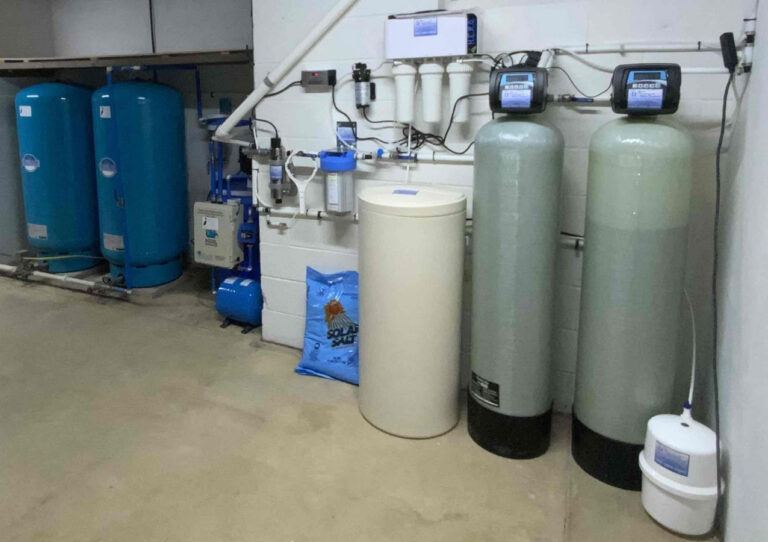
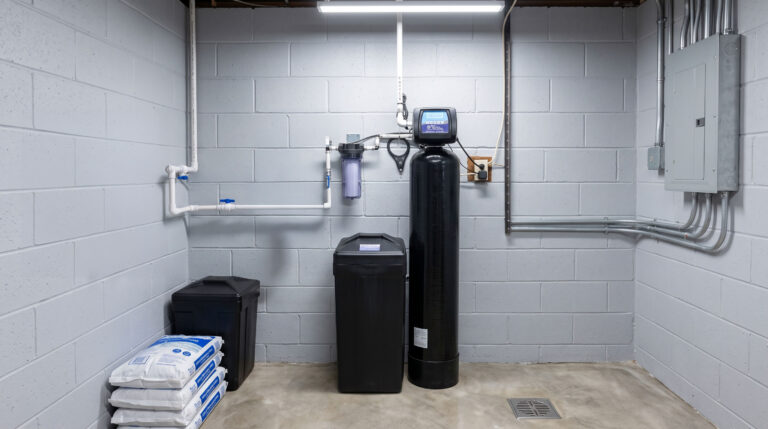
A water softener uses an ion exchange process to remove calcium and magnesium, replacing them with a small amount of sodium. The result is noticeably softer water that’s gentler on your plumbing, appliances, skin, and laundry. For most homes in this region dealing with hard water, a properly sized softener is one of the most impactful investments you can make.
Curious about what the installation process looks like? Read our step-by-step guide to water softener installation and our explanation of how a water softener works.
We regularly run promotions on water softener installations. Check our current offers before you schedule.
See Current Water Softener Specials
Iron Filtration Systems
Iron filtration systems remove dissolved and particulate iron before it reaches your fixtures and appliances. The right system depends on the type and concentration of iron in your water — which is yet another reason the water test comes first. Homes dealing with both iron and hardness often benefit from a combination approach that tackles both issues in sequence.
What iron filtration does NOT address:
UV Disinfection Systems
If your water test reveals bacterial contamination, a UV disinfection system is one of the most effective chemical-free solutions available. UV systems expose water to ultraviolet light, which disrupts the DNA of bacteria, viruses, and other microorganisms — making them unable to reproduce. No added chemicals, no change to taste or smell.
This is the go-to solution for well owners in rural parts of Berks and Chester County where the well casing may be older or surface runoff is a concern. Our article on how UV disinfection protects your water explains the technology in plain terms.
Reverse Osmosis for Drinking Water
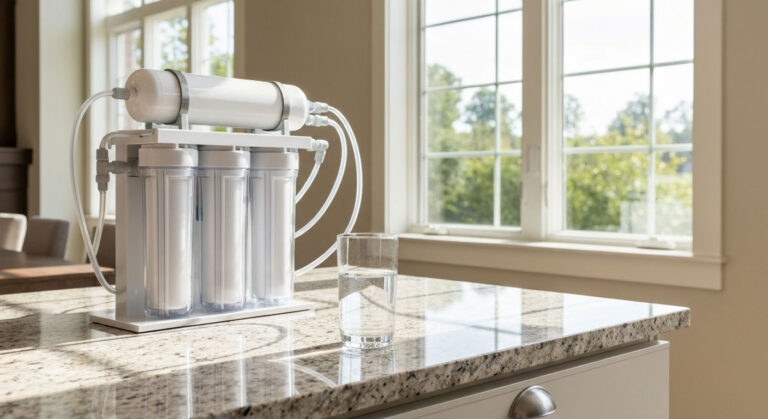
Reverse osmosis (RO) is a point-of-use drinking water system that forces water through a semi-permeable membrane, removing a wide range of contaminants — including PFAS, nitrates, heavy metals, and dissolved solids. It’s typically installed under the kitchen sink and serves your drinking and cooking water specifically.
If your family has concerns about what’s coming out of the tap, an RO system offers a very high level of confidence. Our guide on choosing the right reverse osmosis system walks through the key decisions. And if you’re weighing RO against ultrafiltration, read our comparison for homeowners in the Skippack area.
Neutralizers for Acidic Water
Neutralizers raise the pH of acidic water by passing it through a tank of calcium carbonate or similar media. This protects your pipes, extends the life of your water heater, and stops the corrosive damage that low-pH water causes over time. If your test shows a pH below 7, addressing it early can save you significant repair costs down the road.
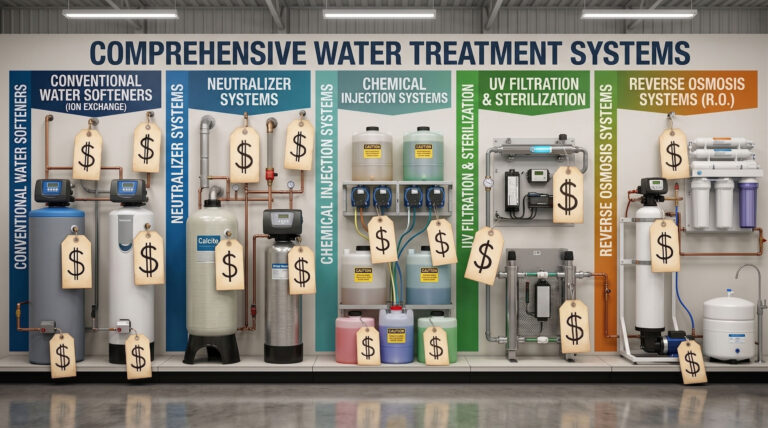
Comparing System Types at a Glance
Water Softener
Removes hardness minerals via ion exchange. Protects pipes, appliances, skin. Sized to your household and test results.
Iron Filtration
Removes dissolved and particulate iron before it reaches your fixtures. Often paired with a softener.
UV Disinfection
Chemical-free disinfection for bacterial contamination. No change to taste or odor.
Reverse Osmosis
Point-of-use drinking water system. Removes PFAS, nitrates, heavy metals, dissolved solids.
pH Neutralizer
Corrects acidic water to protect copper pipes, water heaters, and fixtures from corrosion.
Well Water vs. Municipal Water in Southeastern PA: Does It Change Your Approach?
Yes — and the difference is significant.
Homeowners on municipal water receive treated water that meets EPA primary drinking water standards. But that doesn’t mean it arrives at your tap without concerns. Aging distribution pipes, disinfection byproducts like trihalomethanes, and localized issues can all affect water quality between the treatment plant and your faucet. If you’re in Pottstown, Royersford, Doylestown Borough, or another municipality with an older infrastructure, it’s worth knowing what’s in the water before you write it off as “treated and safe.”
Homeowners on private wells carry full responsibility for their own water quality. There’s no utility monitoring your well. The EPA recommends testing private well water at least once a year — and more frequently after flooding, nearby agricultural activity, or any change in taste, odor, or appearance. Many well owners in Oley, Bechtelsville, and the rural stretches of Montgomery County rely on annual check-ups to catch issues before they become serious.
| Factor | Private Well | Municipal Water |
|---|---|---|
| Who monitors it? | You do — no utility oversight | Municipal authority, EPA-regulated |
| Common concerns | Iron, hardness, bacteria, pH, nitrates | Chlorine byproducts, lead from old pipes, PFAS |
| Testing frequency | At least annually | Recommended if concerns exist |
| Treatment approach | Comprehensive system often needed | Point-of-use filtration often sufficient |
The contaminants you’re likely to encounter also differ by source. Well water in this region frequently shows elevated iron, hardness, and bacterial counts. Municipal water users are more likely to be concerned about disinfection byproducts or lead from older service lines. See our guide on chlorine and chloramine concerns in Pennsylvania if you’re on municipal supply and want a deeper look.
How to Choose a Water Treatment Provider You Can Trust in Southeastern PA
The equipment matters — but so does the company installing and servicing it. Here are a few questions worth asking any water treatment provider before you commit:
Do they start with a water test? Or do they recommend a system before they’ve seen your results? Any reputable company leads with data.
Are their technicians experienced with both well systems and municipal connections? The two require different knowledge, and a provider who works with both gives you more flexibility.
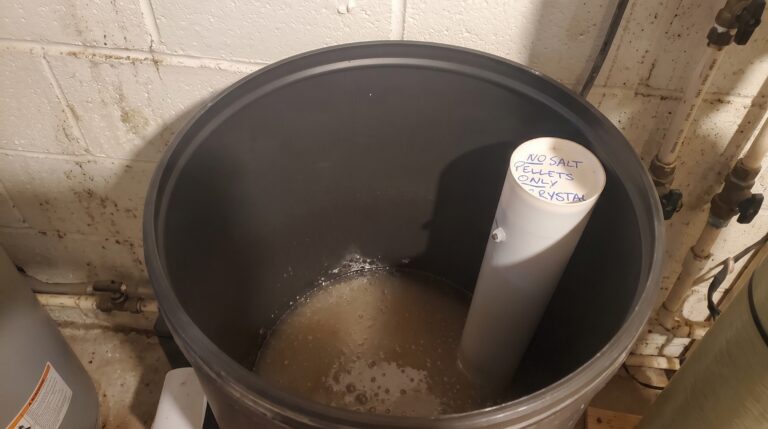
Do they offer ongoing service and maintenance? Not just installation. Water treatment systems need periodic attention — salt, filter replacements, lamp changes — and you want someone local who knows your system.
Are they actually local? Real familiarity with the water chemistry in your county and township isn’t something a national company can replicate. Local knowledge matters.
Dierolf Plumbing and Water Treatment has served homeowners across southeastern Pennsylvania for years, working in communities from Doylestown and Newtown to Boyertown, Royersford, and Kennett Square. Our experienced service technicians handle everything from the initial water test through installation and long-term service. We don’t recommend a system until we’ve seen your water data — because the right solution depends entirely on what’s actually in your water.
Read more about why homeowners choose Dierolf and what to look for when choosing a water treatment company.
💧 Find out exactly what’s in your water — free, in your home, with no obligation.
Schedule Your Free In-Home Water Analysis
We’ll come to your home, test your water on-site, and walk you through exactly what we find — before recommending any system. No pressure. Just answers.
Frequently Asked Questions About Water Treatment in Southeastern Pennsylvania
How do I know which water treatment system I need in Bucks, Berks, Montgomery, or Chester County?
Start with a professional water test. The results show which contaminants are present and at what levels, which makes it possible to match the right system to your actual water quality rather than guessing based on symptoms alone. Schedule your free water analysis and we’ll handle the rest.
Can I have more than one water treatment system in my home?
Yes — and many homes in this region need more than one. A water softener addresses hardness. An iron filter handles iron. A reverse osmosis system provides clean drinking water at the tap. A UV system disinfects bacterial contamination. These systems work together and are often installed in sequence based on your specific water test results.
How often does a water treatment system need to be serviced?
It depends on the system. Water softeners need salt replenished regularly and a periodic service check. Reverse osmosis systems require filter replacements — typically once or twice a year. UV systems need their lamp replaced annually. A service schedule from your installer keeps everything running the way it should. Dierolf Plumbing and Water Treatment offers ongoing service for every system we install.
Is well water safe to drink without treatment in southeastern Pennsylvania?
Not necessarily. Well water in this region can contain bacteria, iron, hardness, nitrates, and other contaminants depending on your location and local geology. Annual testing is the only reliable way to know what’s in your water — and whether treatment is needed. Read more about well water health concerns in Pennsylvania.
Does a water softener remove PFAS?
No. Water softeners are designed to remove hardness minerals through ion exchange and don’t effectively address PFAS or most chemical contaminants. A reverse osmosis system is the appropriate treatment for PFAS reduction at the drinking water level. If you have concerns about PFAS exposure, read our article on PFAS in Bucks County water and our guide on why PFAS filters aren’t all the same.
How long does a water treatment system last?
Most whole-home systems — including water softeners and iron filters — last 10 to 15 years or more with proper maintenance. Reverse osmosis membranes typically last 2 to 5 years depending on water quality and usage. UV lamp replacements are annual. Regular servicing extends the life of any system significantly.
Do I need a water test if I’m on municipal water in Pottstown, Royersford, or Doylestown?
It’s still worth doing — especially if your home has older plumbing, you’ve noticed changes in taste or odor, or you want to understand what’s in your water before investing in treatment. Municipal water meets regulatory standards at the treatment plant, but conditions can change between there and your tap. Older distribution lines and in-home plumbing can introduce lead and other contaminants the utility doesn’t control.
What’s the difference between water filtration, water treatment, and water purification?
These terms are often used interchangeably but have meaningful differences. Read our breakdown of water filtration, water treatment, and water purification to understand which approach fits your situation.